

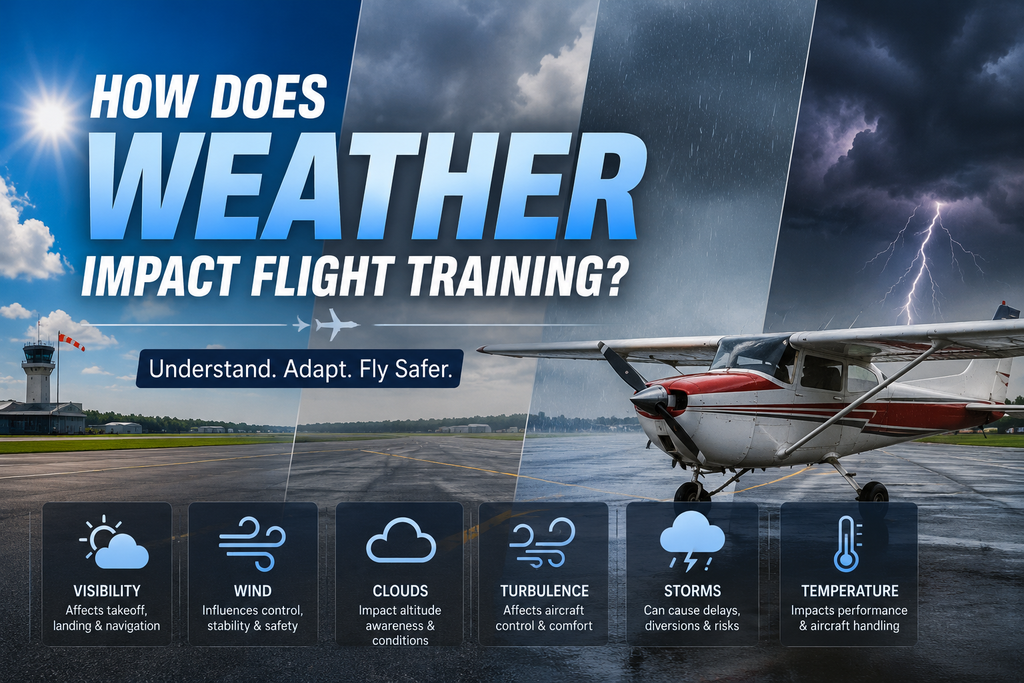
You’ve probably imagined your flight training as a steady march from your first solo to your final skill test. Then the monsoon hits, or a fog bank rolls in over your airfield at 6 am, and suddenly your carefully planned schedule looks nothing like the calendar you made. Weather’s impact on flight training is one of those things nobody warns you about strongly enough before you start, so let’s fix that.
Why Weather’s Impact on Flight Training Starts So Early
Early flight training happens almost entirely under Visual Flight Rules, which means you’re relying on what you can actually see outside the cockpit: the horizon, the runway, other traffic. The moment visibility drops, or crosswinds exceed what a training aircraft can safely handle, your instructor grounds the flight. This is exactly where weather’s impact on flight training becomes obvious for the first time. It’s not caution for caution’s sake. It’s simply how flight training works at this stage, since the aircraft and the syllabus both assume reasonably clear conditions.
Understanding Weather’s Impact on Flight Training, Season by Season
Monsoon Season and Its Effect on Flight Training
If you’re training anywhere in India between June and September, expect your flight training calendar to shrink. Heavy rain, low cloud bases, and gusty crosswinds regularly ground light training aircraft for days at a stretch, and this is where weather’s impact on flight training is most visible across the country. According to a DGCA circular on monsoon operations, operators are even barred from extending duty time limits during monsoon. This is specifically because of the added fatigue risk that weather creates. This is applied to working pilots and reflects just how seriously the regulator treats this season.
Fog and Low Visibility in Winter
Northern India’s winter fog adds another layer to weather’s impact on flight training every year. Dense fog can sit over an airfield well past sunrise, delaying your first flight of the day or cancelling it outright. This is also where you’ll first encounter CAT-III operations, the specialised low-visibility landing systems that commercial pilots eventually need certification on, even though as a student you won’t be flying in these conditions yourself.
Wind, Turbulence, and Thunderstorm Activity
Crosswind limits exist for a reason, and your training aircraft has a lower tolerance for gusty conditions than the commercial jets you’re aiming to fly one day. A thunderstorm cell building nearby, even one that never actually reaches your airfield, is often enough for your instructor to call off a session rather than risk turbulence during a critical manoeuvre like a stall recovery or a solo circuit. Wind and storm activity together round out weather’s impact on flight training across a typical year.
Real Scenarios Where You’ll Feel Weather’s Impact on Flight Training
Weather’s impact on flight training isn’t theoretical. Most cadets run into some version of these situations within their first year:
- Your scheduled solo cross-country gets scrubbed twice in one week due to crosswinds at your destination
- A night flying session gets pushed back because fog is forecast right at your usual takeoff slot
- Your instructor cuts a lesson short mid-flight after spotting building cumulus clouds ahead
- An entire week of monsoon rain pushes your skill test date back by nearly a month
- You lose a booked simulator slot because an earlier aircraft got grounded, backing up the day’s schedule
None of these mean you’re behind or doing something wrong. They’re simply part of how flight training unfolds in a country with genuinely varied weather across seasons.
How Weather’s Impact on Flight Training Shapes Your Timeline
Most flight schools quote a CPL timeline of roughly 24 to 30 months, but that figure typically assumes reasonable aircraft availability and no major weather disruptions. Once you factor in a real monsoon season or a heavier-than-usual fog spell, that number stretches. Training management platforms built for Indian flight schools now include features to automatically redistribute flying hours around monsoon disruptions, which tells you how routine this problem has become industry-wide, not just at your particular academy.
A delay caused by weather isn’t a reflection of your skill or your school’s efficiency. It’s simply the cost of training somewhere with a monsoon, fog-prone winters, and everything in between.
How Flight Schools Prepare You for Weather’s Impact on Flight Training
Good training doesn’t just wait out bad weather; it actively teaches you to work with it. Your Meteorology subject in ground school covers cloud physics, pressure systems, and how to read METARs and TAFs properly, skills you’ll lean on for your entire career, not just your training years. Later, as a working pilot, you’ll also encounter scenario-based training built around adverse weather diversions, following the same aviate-navigate-communicate hierarchy pilots rely on in genuine emergencies.
Real-world consequences reinforce why this matters. Show-cause notices have been issued to major Indian carriers in the past for rostering pilots who weren’t trained for low-visibility CAT-III operations during dense fog. Weather competence isn’t a soft skill here; it’s a regulatory requirement with real penalties attached.
How You Can Minimise Weather’s Impact on Flight Training
You can’t control the weather, but you can control how you respond to it.
- Use grounded days productively by revising Meteorology, Air Navigation, or your last debrief notes
- Keep a personal log of every weather-related cancellation, so patterns become visible over a season
- Ask your instructor to walk you through the day’s METAR and TAF, even when you’re not flying
- Build buffer time into your own mental timeline rather than fixating on the ideal 24-month estimate
- Stay in touch with your school’s scheduling team so you’re first in line when flying windows reopen
In Conclusion
Weather’s impact on flight training is real, occasionally frustrating, and completely unavoidable if you’re training in India. The cadets who handle it best aren’t the ones who get lucky with clear skies; they’re the ones who treat every grounded day as extra preparation rather than lost time.
Build a Weather-Ready Foundation with Cockpit Lessons
At Cockpit Lessons, we prepare cadets for the realities of flight training in India- monsoons, fog, and all- right from your ground classes. Get in touch with us to start building a foundation that holds up no matter what the sky throws at you.
Frequently Asked Questions (FAQs)
1. Will weather-related delays increase my flight training cost?
Possibly, since extended timelines can mean additional aircraft rental or accommodation costs. Ask your school upfront how they handle fees around weather-related delays.
2. What happens to my DGCA exam dates if my training gets delayed by weather?
Your DGCA theory exam bookings are generally independent of your flying schedule, so you can keep clearing subjects even during a grounded stretch.
3. What should I do productively on days when flying is cancelled?
Use the time for focused ground revision, simulator practice if available, or reviewing your logbook and previous debriefs.
4. Do all Indian flight training bases face the same weather challenges?
No, some regions, particularly Gujarat and parts of Madhya Pradesh, see fewer monsoon disruptions, while northern bases deal with more winter fog and eastern coastal bases see heavier monsoon activity.
5. Is training abroad a good way to avoid weather-related delays?
It can help in some cases, since certain countries have more predictable flying weather, but it adds its own costs and logistics. Weather delays here are manageable with good planning.
Location – https://share.google/L1kVBqZC90mucYHMJ