

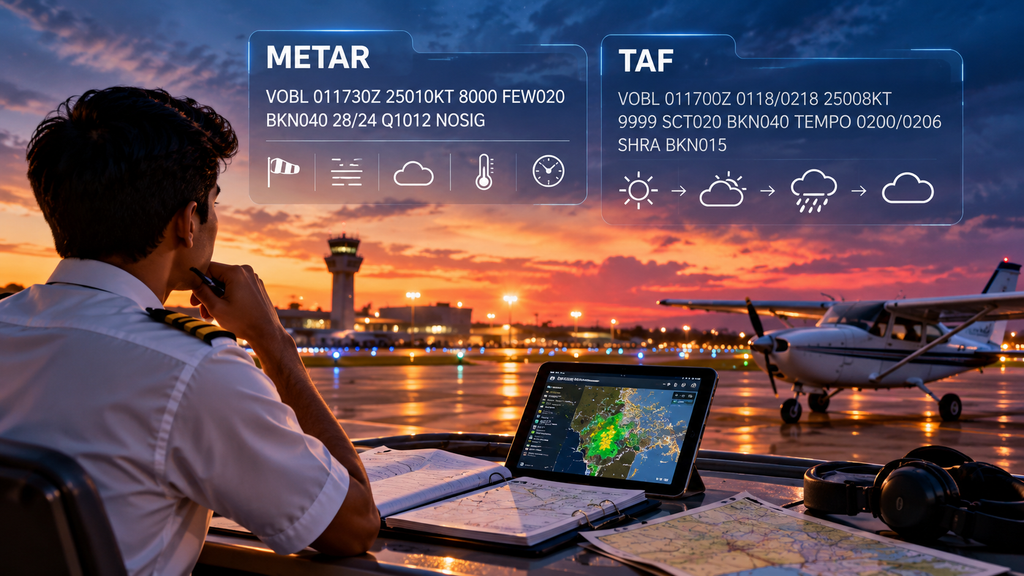
When you become a pilot, checking the weather before starting the engines, and METAR and TAF, becomes your daily ritual. During commercial pilot licence training, you will read them almost daily. The CPL Meteorology paper tests them too, and the ATPL paper goes deeper into the subject.
This guide will explain what METAR and TAF are and how to read them, using Indian airports as examples.
What Are METAR and TAF?
A METAR is all about a routine weather update of what the weather is at an aerodrome at present. In India, the India Meteorological Department (IMD) issues these reports, usually every 30 minutes.
However, when the weather changes sharply in between, a SPECI (special report) goes out.
A TAF, on the other hand, is a forecast for the same aerodrome that tells you what the weather is expected to do over the next several hours. One important thing to note is that a TAF remains valid for 9, 24 or 30 hours depending on the airport.
If you want to be a skilled pilot, you will have to learn to use METAR and TAF simultaneously, because one report alone is never enough to get the complete picture of the weather.
Both METAR and TAF use ICAO codes and UTC time, shown with a “Z”. Indian Standard Time is UTC plus 5 hours 30 minutes, so 0500Z means 10:30 AM in India.
How to Read a METAR
Every METAR follows a fixed order. Ground classes in Commercial pilot licence training cover it early, and once you learn the order, decoding gets quick.
A Sample METAR from Bengaluru
Here is a made-up example:
METAR VOBL 151030Z 24008KT 4000 -RA BKN015 25/22 Q1010 TEMPO 2000 RA
Let’s break it down group by group:
METAR: The report type. A special report would show SPECI here.
VOBL: The four-letter ICAO code. VOBL is the code name for Bengaluru, while VIDP refers to Delhi, and VABB means Mumbai.
151030Z: The 15th day of the month, at 1030 UTC.
24008KT: Wind is from 240 degrees at 8 knots. Direction is always the direction the wind blows from.
4000: Visibility is 4,000 metres. A value of 9999 means 10 km or more.
-RA: Light rain. The ‘minus sign’ refers to light rain; no sign means moderate, and a plus sign means heavy rain.
BKN015: Broken cloud at 1,500 feet above the aerodrome.
25/22: Temperature is 25°C and dew point is 22°C.
Q1010: QNH is 1010 hPa. This is your altimeter setting.
TEMPO 2000 RA: A short-term trend. Visibility may drop temporarily to 2,000 metres in rain.
Never Forget the Cloud Codes
Cloud amount is reported in oktas, which are eighths of the sky. Here is how to remember easily:
- FEW = 1 to 2 oktas
- SCT (scattered) = 3 to 4
- BKN (broken) = 5 to 7
- OVC (overcast) = 8
You might mix up SCT and BKN in exams; don’t worry, revise them regularly to memorise the codes by heart. Also, cumulonimbus* is added as CB, such as FEW025CB. CB means thunderstorm risk.
*It is a type of cloud which accumulates a very large and high mass, having a flat base (at a low level) and top. (keep it in italics)
What CAVOK Really Means
CAVOK stands for Ceiling and Visibility OK. It is used only when three things are true together. Visibility is 10 km or more. There is no cloud below 5,000 feet or the highest minimum sector altitude, whichever is higher, and no cumulonimbus. There is also no significant weather.
Please note that 9999 is not the same as CAVOK. A sky with 9999 visibility can still have low cloud.
How to Read a TAF
A TAF looks like a METAR but adds a validity period and change groups. Every ATPL and CPL candidate must decode it fluently. Here is a sample for Delhi:
TAF VIDP 150500Z 1506/1612 27008KT 2000 HZ SCT020 BECMG 1509/1511 9999 NSW TEMPO 1514/1518 4000 TSRA SCT020CB
TAF VIDP 150500Z: Forecast for Delhi, issued on the 15th at 0500 UTC.
1506/1612: Valid from 0600 UTC on the 15th to 1200 UTC on the 16th. That is 30 hours.
27008KT 2000 HZ SCT020: The starting forecast. Wind 270 degrees at 8 knots, 2,000 metres in haze, scattered cloud at 2,000 feet.
BECMG 1509/1511 9999 NSW: Gradual change between 0900 and 1100 UTC. Visibility improves to 10 km, and no significant weather is expected.
TEMPO 1514/1518 4000 TSRA SCT020CB: Between 1400 and 1800 UTC, thunderstorms with rain may bring temporary visibility of 4,000 metres.
TAF Change Groups Explained
Change groups tell you how the weather will move during the forecast. BECMG means a gradual and lasting change. TEMPO means brief fluctuations, each lasting less than an hour, and together covering less than half the period. FM means a rapid change from a given time. PROB30 or PROB40 shows a 30% or 40% chance of the stated weather.
PROB only shows a possibility. Do not read it as a confirmed event. These groups also drive fuel and alternate planning in Commercial pilot licence training.
METAR vs TAF at a Glance
This table compares METAR and TAF and works as a quick revision sheet before your CPL Meteorology exam.
| Feature | METAR | TAF |
| Purpose | Reports actual weather now | Forecasts weather ahead |
| Validity | One moment in time (with a 2-hour trend) | Usually 9, 24 or 30 hours |
| Update | Every 30 minutes, or hourly at some airports | Issued at fixed times, amended if needed |
| Change words | NOSIG, BECMG, TEMPO in the trend | BECMG, TEMPO, FM, PROB |
| Special report | SPECI when conditions change fast | Amendment (AMD) when the forecast fails |
| Best use | Deciding if you can depart now | Planning route, fuel and alternates |
Table 1: Features of METAR and TAF
Why METAR and TAF Matter for Indian Pilots
India’s weather changes a lot from region to region, and Commercial pilot licence training here has to prepare you for all of it. Mumbai and Kochi face heavy monsoon rain. Delhi and Lucknow struggle with winter fog. Bengaluru can see sudden thunderstorms. Reading the reports correctly helps you plan for each of these, whether you are a student pilot or an ATPL holder.
Watch the temperature and dew point closely. When they are within 2 or 3 degrees of each other, fog or low cloud is likely, especially at night and early morning.
Visibility codes matter too. FG means fog (below 1,000 metres). BR means mist (1,000 to 5,000 metres). HZ means haze. Low visibility can shut down an approach, so it shapes your choice of alternate.
Tips to Learn METAR and TAF Faster
Real reports are the best practice during Commercial pilot licence training. Pick a few Indian airports and decode the METAR and TAF every morning. Check your answer with a decoder later.
Write common codes on a small card. Practise UTC-to-IST conversions until they become automatic.
Keep the habit beyond the exam. It matters again for the ATPL papers, and even more in the cockpit, where a wrong reading can affect a real flight.
Final Thoughts
METAR and TAF are not just codes to memorise for the CPL exam. They help you decide whether to fly, where to divert and how much fuel to carry. Start with the fixed order, learn the cloud and visibility codes, and practise daily. Within weeks, the reports will read like plain sentences.
The skill stays with you from your first CPL sortie to your ATPL interview.
Learn Meteorology with Cockpit Lessons
Looking for Commercial pilot licence training in Bangalore? Cockpit Lessons offers ground classes where experienced instructors help you master METAR and TAF and every other Meteorology topic from the basics. Book your CPL and ATPL ground class slot today.