

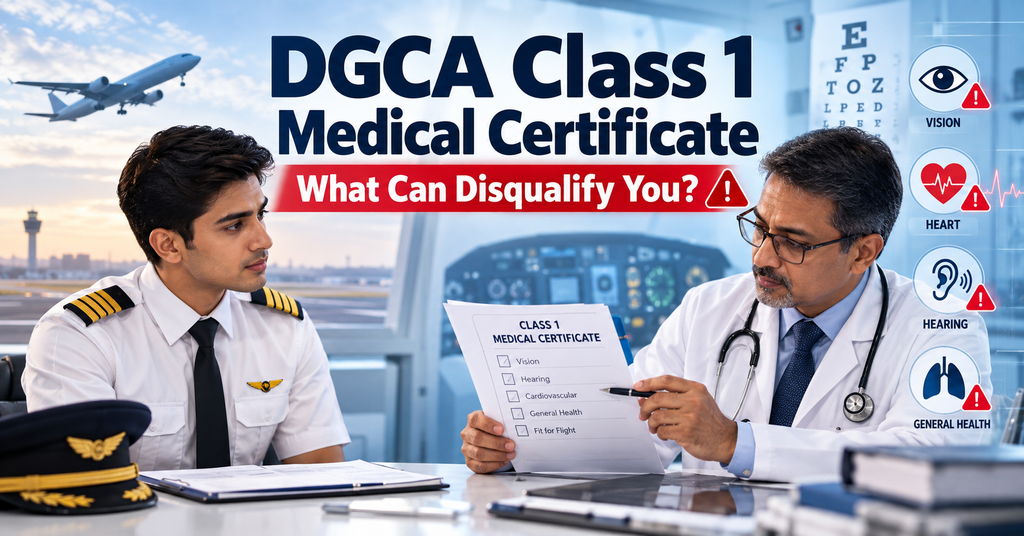
Most aspiring pilots research flying schools and fees first. The medical comes later, often after money is already spent. That order is backwards. A Class 1 medical certificate is the one requirement no amount of ground school preparation can fix, and it stands directly between you and your commercial pilot licence. This blog covers exactly what can disqualify you, and what genuinely won’t.
Class 1 vs Class 2 Medical Certificate: What’s the Difference?
DGCA runs two separate medical categories for fixed-wing pilots, and knowing the difference matters more than most cadets realise.
Class 2 Medical Certificate: Your Starting Point
A Class 2 medical certificate is the first step to your medical screening to get the Student Pilot Licence and begin flying training. In this stage you are checked for your colour vision, baseline eyesight, hearing, and general fitness.
Class 1 Medical Certificate: The Real Test
A Class 1 medical certificate is far more rigorous, and it’s mandatory before DGCA issues a commercial pilot licence. It adds a detailed cardiac workup, neurological screening, full blood and urine tests, a chest X-ray, and a closer look at psychological fitness. Some candidates clear Class 2 comfortably and still run into findings at the Class 1 stage, which is exactly why this shouldn’t wait until your CPL is already underway.
What Can Permanently Disqualify You from a Class 1 Medical Certificate?
A small number of findings are treated as absolute under current DGCA standards. There’s no waiver and no appeal process for these.
| Condition | Why It Disqualifies |
| Colour vision deficiency, any degree | Pilots must read cockpit displays and signal lighting by colour. Should be tested using the Ishihara chart |
| History of seizures or epilepsy | Treated as an unacceptable risk of sudden incapacitation mid-flight |
| Certain organic cardiac conditions | Structural heart findings on ECG or echocardiogram carry genuine incapacitation risk |
| Serious neurological or substance-use history | Anything affecting consciousness, cognition, or in-flight judgement is taken seriously |
Table 1: Possible reasons for disqualification in Class 1 Medical Certificate test
Colour vision deficiency catches the most people off guard. It causes no symptoms in daily life and doesn’t show up in a board exam, so many cadets only discover it during their first medical, sometimes after months of ground classes. An Ishihara test takes two minutes at any optician. Get this checked in week one, not month six.
Vision Standards: Glasses Are Fine, Colour Blindness Isn’t
A common myth is that pilots need naturally perfect eyesight. That’s not true. DGCA accepts corrected vision for a Class 1 medical certificate, as long as it reaches the required standard with glasses or contact lenses, and your refractive error sits within an accepted range. Most candidates pursuing a commercial pilot licence with ordinary short or long-sightedness pass this part without much trouble.
LASIK surgery is accepted too, with conditions. It should generally be done after age 20, your post-operative refraction needs to stay stable for several months, and you’ll need pre-operative records plus a stability report from your ophthalmologist. If LASIK is part of your plan, get it done early and keep every document.
What glasses and LASIK can’t fix is colour vision itself. That’s the one vision-related standard where correction simply doesn’t apply.
BMI: The Most Common, Most Fixable Roadblock
If colour vision is the disqualifier nobody checks for, BMI is the one nearly everybody underestimates when preparing for a Class 1 medical certificate. Unlike colour vision, this one is fully within your control.
DGCA generally prefers a BMI between 18.5 and 25. Between 25 and 30, candidates are often cleared, sometimes with a note on file. Above 30, the usual outcome is Temporarily Unfit, along with additional blood sugar testing and a few months to bring your weight down before re-examination. Being significantly underweight can trigger a similar temporary hold. None of this is permanent, but it’s worth addressing months before your appointment, not the week before.
Other Checks Worth Preparing For
Beyond eyesight, colour vision, and BMI, a Class 1 medical certificate covers several other systems. None of these are exotic, but each can produce an unpleasant surprise if you walk in unprepared.
- Hearing is tested with a whisper test and pure-tone audiometry. Wax buildup causes more failed first attempts than anything genuinely wrong with your hearing ability.
- An ECG checks your cardiovascular health. If you are diagnosed with heart murmur, it will not automatically disqualify you. The official guidelines distinguish harmless functional murmurs from structural ones.
- Blood and urine work covers haemoglobin, fasting sugar, lipids, and liver function. Low haemoglobin is a common, easily correctable reason for deferral.
- High blood pressure readings can be a red flag. If you tend to run high under stress, track your BP for a couple of weeks beforehand so you know your real baseline.
- A brief psychological screening is included to evaluate your mood, stress response, and disclosed history.
Yes, you all want to pass the medical tests but honesty on your medical form matters far more than anything. Your fitness is key to a safe flight for you and your borders as well.
Temporarily Unfit vs Permanently Unfit
These two outcomes get confused often, and that confusion causes a lot of unnecessary panic. Temporarily Unfit means a specific, named issue, high BMI, low haemoglobin, ear wax, has been flagged with a defined window to fix it and return. Most first-time findings fall here, and most candidates clear on their second attempt.
Permanently Unfit is reserved for the conditions covered earlier, colour vision deficiency, seizure history, and certain confirmed cardiac issues, where current regulation doesn’t offer a path back. If you’re given this finding, get it in writing and understand exactly which condition triggered it before assuming the door is fully shut.
How and Where to Get It Done
The process runs through DGCA‘s eGCA portal. You’ll need a Computer Number first, after which you can book your examination slot for your Class 1 medical certificate. These exams happen at a limited number of authorised centres, including Air Force-affiliated ones like AFCME in Delhi and the Institute of Aerospace Medicine in Bengaluru, alongside a few approved civil hospitals. These slots fill up fast, especially around peak enrolment months, so book well ahead of when you actually need the result.
Expect the exam itself to take one to two days, and results usually appear on your eGCA profile within a few weeks. A Class 1 medical certificate is typically valid for 12 months under age 40, and 6 months above that, so keep renewal dates firmly on your calendar throughout training and beyond.
Why the Class 2 Medical Certificate Should Come First
Before you enrol anywhere for a commercial pilot licence, get a Class 2 medical certificate done independently. It costs a fraction of a month’s ground school fees and resolves the one variable no amount of preparation or money can change afterwards.
Final Words
A Class 1 medical certificate isn’t something to think about after you’ve already paid for training. Check your colour vision, track your BMI, and get a Class 2 medical certificate done in your first week of research, not your sixth month. It’s the cheapest, fastest way to know exactly where you stand.
Start Your Journey Right with Pioneer Flying Academy
At Pioneer Flying Academy, we guide every cadet through what their medical journey actually requires, alongside their commercial pilot licence training. Besides, we also advise students to go through the Class 2 Medical test before committing to the course. A clear medical picture early on means your commercial pilot licence timeline stays realistic from day one, instead of getting disrupted by a preventable surprise later. Get in touch with us to plan your path with clarity from the start.