

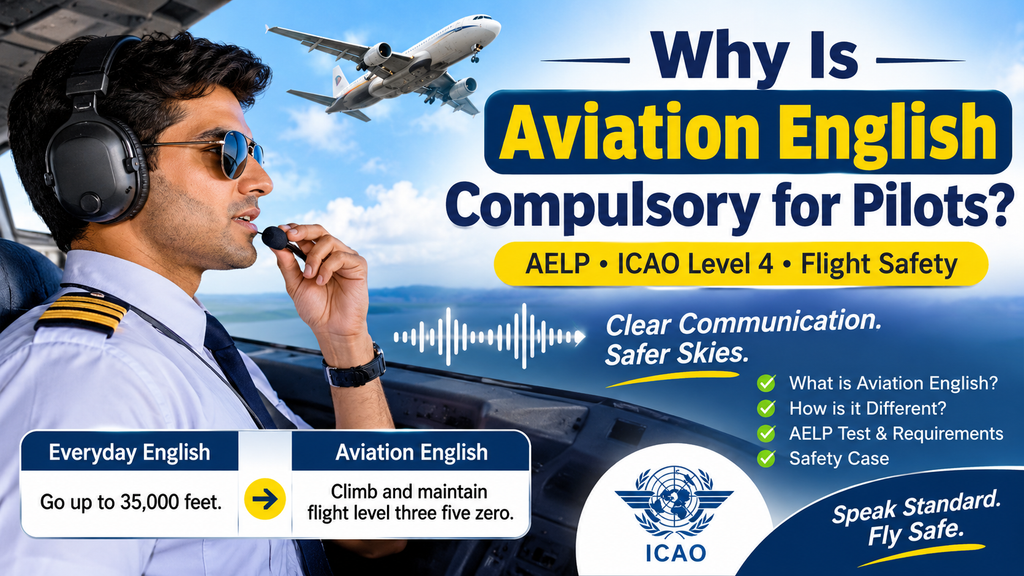
When you are flying an aircraft at 30,000 feet, clear communication with the co-pilot and Air Traffic Control (ATC) is essential for a safe flight. Every instruction must be understood correctly the first time by both sides. This is why Aviation English is compulsory for pilots.
It is not just a way of communicating; it is an essential part of aviation safety. In this blog, we will discuss why Aviation English is important, how it differs from everyday English, and what pilots need to know about the Aviation English Language Proficiency (AELP) test.
What Is Aviation English?
Aviation English is the standard form of English used by pilots and air traffic controllers to communicate with each other.
However, you do not need to learn an entirely different language to master Aviation English. It is based on plain English, combined with standardised phraseology designed specifically for aviation communication.
English is spoken worldwide, but people from different countries and regions have different accents and speaking styles. This can sometimes make communication difficult, especially over radio frequencies.
To reduce the risk of misunderstanding, the International Civil Aviation Organization (ICAO) has established standard aviation phraseology.
For example, a pilot from Kolkata and an air traffic controller from Frankfurt may communicate in English. However, using standard Aviation English makes their communication more predictable and easier to understand.
Let’s look at an example:
ATC: Air India four-zero-two, climb and maintain flight level three-fiver-zero.
Pilot: Climbing to flight level three-fiver-zero, Air India four-zero-two.
Here, the pilot is instructed to climb to and maintain Flight Level 350 (FL350), which corresponds to approximately 35,000 feet under standard pressure conditions.
Using standard number pronunciation reduces the chances of miscommunication and helps ensure flight safety.
To ensure pilots possess the required communication skills, they must meet the Aviation English Language Proficiency (AELP) requirements.
How Is Aviation English Different from Ordinary English?
We use ordinary English to communicate and express our feelings in everyday situations. It often includes polite expressions, idioms, and different ways of communicating the same message.
Aviation English, on the other hand, focuses on accuracy, clarity, and brevity. It removes unnecessary words and expressions that could be misunderstood over radio communication.
There are three major differences:
1. Short and Standardised Phrases
In Aviation English, standard phraseology keeps messages short, clear, and predictable.
Pilots and controllers expect specific words and phrases in particular situations. This makes communication easier to understand and helps identify potential mistakes.
2. Plain Language for Unexpected Situations
Not every situation can be covered by standard aviation phraseology.
When an unusual or emergency situation occurs, pilots must communicate using clear and simple English.
Aviation English training also focuses on this skill because emergency communication requires calm, short sentences and accurate information without unnecessary expressions or slang.
3. Readback: Confirming What You Heard
Readback is one of the most important habits pilots develop during their Aviation English and radio communication training.
Pilots repeat important ATC instructions, particularly those related to:
- Altitude
- Heading
- Runway assignments
- Clearances
- Radio frequencies
The controller listens to the readback and corrects any errors if necessary.
This two-way confirmation helps reduce communication errors and improves flight safety.
Everyday English vs Aviation English
| Everyday English | Aviation English |
|---|---|
| Go up to 35,000 feet. | Climb and maintain flight level three five zero. |
| Yes | Affirm |
| No | Negative |
| Okay, got it. | Roger |
| Nine | Niner |
| Wait a moment. | Standby |
Table 1: Difference between Everyday English and Aviation English.
Why Is Aviation English Compulsory for Pilots? The Safety Case
Radio communication is the primary link between pilots and Air Traffic Control.
A weak radio signal, unfamiliar accent, background noise, or heavy workload can make instructions difficult to understand. If a pilot misunderstands an important instruction, it can create a serious safety risk.
Aviation history has several examples of how communication failures can contribute to aviation accidents.
What Happened Over Charkhi Dadri?
India has seen what a language gap can cost. On 12 November 1996, a Saudi Boeing 747 and a Kazakhstan Airlines Il-76 collided near Charkhi Dadri in Haryana. All 349 people on both aircraft died.
The inquiry found that the Kazakh crew had descended below its assigned altitude. Poor knowledge of English among the Kazakh pilots contributed to the fatal accident. The pilots relied on a radio operator (the only English-speaking person in the cockpit) to talk to Delhi ATC.
Such accidents are also one of the reasons why aviation English has become an integral part of pilot licence requirements nowadays.
What Does the DGCA Require for Aviation English in India?
The Directorate General of Civil Aviation (DGCA) follows ICAO standards for aviation language proficiency.
For pilots in India, this includes meeting the required Aviation English Language Proficiency level, with ICAO Level 4 (Operational) being the minimum standard.
Here are the important points you should know:
Minimum ICAO Level
The minimum required proficiency is ICAO Level 4 (Operational). The ICAO language proficiency scale ranges from Level 1 to Level 6.
Six Areas of Assessment
The AELP assessment evaluates pilots across six areas:
- Pronunciation
- Structure
- Vocabulary
- Fluency
- Comprehension
- Interaction
Training Requirements
Candidates must fulfil the applicable DGCA training requirements before appearing for the assessment. Check the latest approved training requirements with the DGCA or an authorised training organisation.
AELP Validity
The validity of an ICAO language proficiency endorsement depends on the level achieved:
| ICAO Level | Validity |
|---|---|
| Level 4 | 3 years |
| Level 5 | 6 years |
| Level 6 | No expiry |
When Do You Need AELP?
You need to meet the applicable language proficiency requirements as part of the pilot licensing process, including the requirements relevant to obtaining a Commercial Pilot Licence (CPL).
The same language proficiency standards also apply to pilots progressing towards an Airline Transport Pilot Licence (ATPL).
Note: DGCA requirements and procedures may change. Always verify the latest regulations and applicable requirements before applying.
What Is the AELP Test Like?
The Aviation English Language Proficiency (AELP) test is a practical language assessment rather than a traditional written examination.
During the assessment, an approved rater evaluates how well you speak, understand, and respond in aviation-related situations.
Your performance is assessed across the six ICAO language proficiency areas, and you receive a proficiency level from 1 to 6.
You do not need to speak English with a particular accent or use perfect grammar in every sentence. However, you must communicate clearly, understand instructions, and explain situations accurately.
The examiner evaluates whether you can:
- Communicate clearly and effectively.
- Understand ATC instructions.
- Respond appropriately to different situations.
- Explain unexpected or emergency situations.
- Maintain effective communication under pressure.
If you score below Level 4, you will need further training and reassessment according to the applicable procedures.
Your approved training organisation can guide you regarding the assessment process and retest requirements.
AELP and RTR(A): What Is the Difference?
Many aviation students confuse RTR(A) with the Aviation English Language Proficiency (AELP) test.
Although both are related to aviation communication, they serve different purposes.
RTR(A) (Radio Telephony Restricted) examination focuses on radio telephony knowledge, communication procedures, and standard phraseology.
AELP assessment evaluates your ability to speak and understand English in aviation-related situations.
| RTR(A) | AELP |
|---|---|
| Tests radio telephony knowledge and procedures. | Tests English language proficiency. |
| Focuses on radio communication and phraseology. | Focuses on six language proficiency areas. |
| Part of the radio telephony qualification process. | Measures ICAO language proficiency. |
| Requires knowledge of aviation communication procedures. | Requires the ability to communicate clearly and effectively. |
Both have separate requirements in the pilot licensing process. One does not replace the other.
How to Improve Your Aviation English During Pilot Training
The best way to develop strong Aviation English skills is to start practising early during your pilot training.
Here are some practical ways to improve your communication:
1. Listen to Real ATC Recordings
Listen to real ATC recordings to understand how pilots and controllers communicate. Pay attention to pronunciation, standard phrases, and the way instructions are delivered.
2. Practise Readbacks
Practise repeating ATC instructions aloud. Focus on numbers, altitudes, headings, and runway clearances.
3. Learn Standard Aviation Phraseology
Understand common aviation phrases and their correct usage. This will also help you prepare for your RTR(A) examination.
4. Improve Your Pronunciation
Speak slowly and clearly rather than trying to speak quickly. Record your voice and listen to identify pronunciation mistakes.
5. Practise Emergency Communication
Learn how to explain unusual situations using simple, direct English. Practise communicating important information without unnecessary words.
Many students in India grow up speaking Hindi, Bengali, Tamil, or other regional languages at home and learn English at school.
If English is your second language, you do not need to worry. Your native language or accent does not automatically prevent you from achieving the required ICAO proficiency level. What matters is whether you can communicate clearly and effectively.
Keep Your Aviation English Proficiency Level Current as a Licensed Pilot
Obtaining your pilot licence does not mean your language proficiency requirements are permanently completed.
Your AELP endorsement has a validity period depending on the ICAO level you achieve.
- Level 4: Requires reassessment every 3 years.
- Level 5: Requires reassessment every 6 years.
- Level 6: Does not expire under the ICAO validity framework.
Many pilots aim for Level 5 or Level 6 because these levels offer longer validity.
However, maintaining effective communication skills is important throughout your aviation career, regardless of your proficiency level.
Conclusion
Aviation English is compulsory because communication is an essential part of the flight safety system.
From understanding ATC instructions to handling unexpected situations, pilots must communicate clearly and accurately at every stage of a flight.
Developing strong Aviation English skills not only helps you meet licensing requirements but also prepares you for the real communication challenges of professional aviation.
At Cockpit Lessons, our DGCA ground classes cover the radio telephony knowledge required for your CPL examinations. Combine this with the appropriate DGCA-approved language training to prepare for both the RTR(A) examination and the AELP assessment.
If you want to start your pilot training with strong aviation communication fundamentals, get in touch with Cockpit Lessons.
Frequently Asked Questions (FAQs)
1. What does AELP stand for?
AELP stands for Aviation English Language Proficiency. It is an assessment of a pilot’s ability to communicate effectively in English in aviation-related situations.
2. Who should complete AELP?
Aviation English language proficiency requirements primarily apply to pilots and air traffic controllers who use radiotelephony communication. Pilots must meet the minimum ICAO Level 4 (Operational) requirement.
3. What are the six areas assessed in the AELP test?
The six areas assessed during the Aviation English Language Proficiency test are:
- Pronunciation
- Structure
- Vocabulary
- Fluency
- Comprehension
- Interaction
4. What are the requirements for DGCA AELP training?
Candidates must fulfil the applicable eligibility and training requirements specified by the DGCA and the approved training organisation. Contact an authorised organisation for the latest age, educational qualification, and training requirements.
5. Can I complete AELP training while pursuing CPL?
Yes. You can undertake Aviation English training alongside your CPL preparation, subject to the applicable training and assessment requirements.
6. Is Aviation English different from normal English?
Yes. Aviation English uses standardised phraseology, specific pronunciation conventions, and clear communication techniques to reduce misunderstandings between pilots and air traffic controllers.
7. What is the minimum ICAO English proficiency level required for pilots?
ICAO Level 4 (Operational) is the minimum language proficiency level required for international radiotelephony communication.