

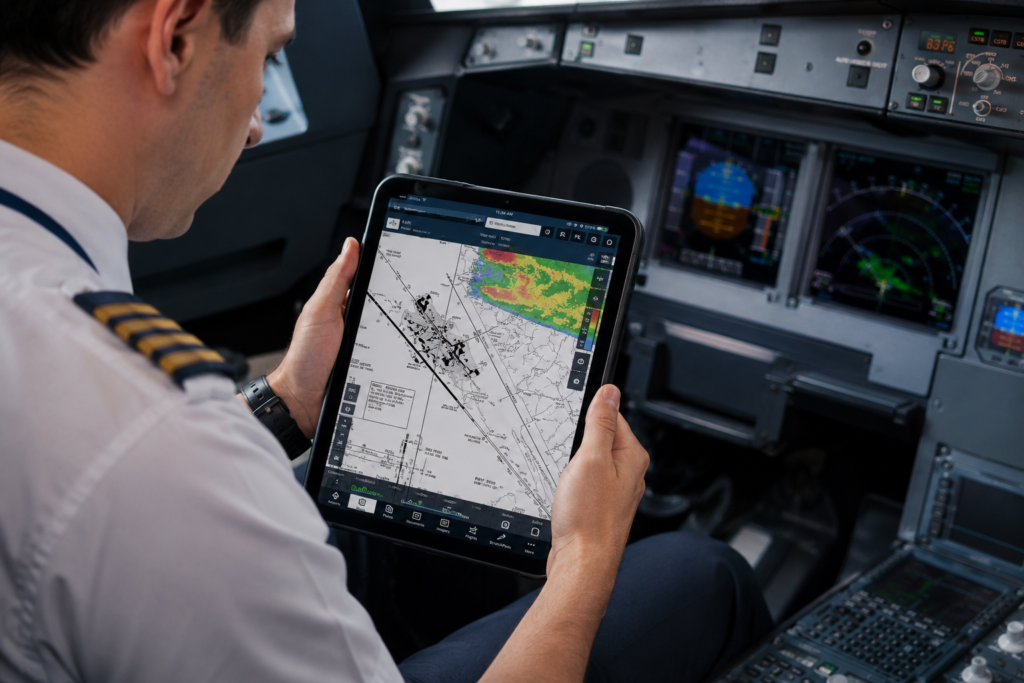
Remember the days when pilots dragged heavy, black leather bags? Those bags were stuffed with thousands of pages of manuals, charts, and flight plans. Needless to say, it was a physical burden.
Today, the aviation industry has undergone a massive digital transformation. The traditional paper-heavy cockpit is rapidly becoming a thing of the past. At the center of this revolution is a powerful digital tool – the Electronic Flight Bag.
Let’s explore how this technology is changing flight training and daily operations.
What is an Electronic Flight Bag (EFB)?
EFB is a digital information management system that helps flight crews perform tasks more easily. It replaces the traditional paper reference material that pilots used to carry.
But it is much more than just a simple PDF reader. It is a comprehensive tool that calculates performance, displays real-time weather, and provides interactive navigational charts.
During your commercial pilot training, you will quickly realize how crucial this system is. It streamlines cockpit operations and reduces the pilot’s workload significantly.
Besides, EFB ensures that you always have the most up-to-date aeronautical information at your fingertips. You no longer spend hours manually replacing paper chart revisions.
The Directorate General of Civil Aviation (DGCA) and other regulatory bodies have fully embraced this technology. They recognize that it enhances situational awareness and flight safety.
The Evolution: From Paper to the Electronic Flight Bag iPad
The transition from paper to the digital cockpit didn’t happen overnight. Initially, early digital systems were bulky, heavy, and incredibly expensive to install.
However, the introduction of commercial tablets changed the aviation game entirely. The launch of the electronic flight bag iPad made digital cockpits accessible and affordable for flight schools.
Airlines around the world quickly realized the massive financial and environmental benefits of this technological shift. For instance, American Airlines saved 400,000 gallons of fuel annually by replacing heavy kitbags with tablets.
And this was just the beginning of the digital revolution in the skies. Soon, other major airlines followed the same path, eliminating millions of pages of paper from their flight decks.
In 2015, Indigo first started replacing manual papers on its Airbus fleet. This marked the start of EFB adoption in Indian aviation.
Today, this digital tablet is a standard sight in both commercial airliners and training aircraft. It allows student pilots to learn on the exact technology they will use professionally.
Types of electronic flight bags
As you dive deeper into aviation, you will encounter various EFB models. They are generally categorized based on their hardware and software capabilities. Before you become a professional pilot, you must understand different types of electronic flight bags available for aspiring commercial pilots. It helps you know what equipment you will be working with.
The aviation industry classifies these devices into three main categories. Let’s look at a detailed comparison of the different classes to understand their unique benefits.
Class 1, Class 2, and Class 3 EFBs
| Class Type | Description | Hardware Integration | Typical Usage |
| Class 1 | Portable commercial off-the-shelf (COTS) devices like tablets | Not attached to the aircraft; stowed during takeoff and landing | Basic flight planning, viewing PDF manuals, and chart reading |
| Class 2 | Portable devices that are mounted in the cockpit | Connected to aircraft power and data systems | Performance calculations, live weather updates, and interactive navigation |
| Class 3 | Installed equipment integrated directly into the aircraft’s avionics | Hardwired and requires strict FAA certification | Comprehensive flight management in advanced commercial airliners |
Table 1: Different types of EFBs available in the aviation industry
Needless to say, flight schools primarily use Class 1 and Class 2 devices for training purposes. They are cost-effective and provide all the necessary functionalities for student pilots.
Key Benefits of Using an EFB or Electronic Flight Bag in Training
When you use an EFB or Electronic Flight Bag in your ground school, you will get numerous advantages.
Here are some of the key benefits you will experience during your pilot training:
- Massive Weight Reduction: Replacing 40 pounds of paper with a 1.5-pound tablet saves fuel and prevents pilot back injuries.
- Real-Time Updates: Pilots receive instant updates on weather, NOTAMs, and chart revisions. This ensures maximum safety and compliance.
- Enhanced Cockpit Organization: A digital device eliminates cockpit clutter. It allows students to focus entirely on flying the aircraft.
- Cost Efficiency: Flight schools and airlines save millions on printing, distributing, and managing paper manuals.
- Interactive Learning: Digital platforms offer interactive charts and performance calculators. They make complex aviation theory much easier to grasp.
Besides, the global adoption rate of this technology speaks for itself. Over 70% of commercial aircraft are equipped with an EFB solution, as per data from 2023.
This proves that mastering these tools is no longer optional for students. It is an absolute necessity if you want to succeed in the modern aviation industry.
Balancing Technology: Avoiding EFB Dependency
While technology is fantastic, it comes with its own set of unique challenges. One major concern in modern flight training is the over-reliance on digital screens.
But a skilled pilot must never become entirely dependent on a digital tablet. You must always be prepared for unexpected technological failures in the cockpit.
During your training, instructors will emphasize the importance of fundamental flying skills. You must know how to navigate using traditional methods if your device fails.
Target fascination – staring at the screen instead of looking outside-is a real danger. It can lead to a loss of situational awareness, which is critical during flight.
However, the goal is to use the tablet as a helpful aid, not a crutch. You should maintain your situational awareness and keep your eyes outside the cockpit.
At the end of the day, you are flying the airplane, not the tablet. Your stick-and-rudder skills will always be your most valuable asset as a pilot.
Final words
The aviation landscape is continuously evolving, and digital tools are leading the charge. These devices have successfully bridged the gap between complex flight data and user-friendly interfaces.
It has made flying safer, more efficient, and significantly more environmentally friendly. The days of messy cockpits filled with scattered approach plates are finally over.
And, as a student pilot, embracing this electronic flight bag technology early on will give you a significant advantage. Just remember to balance your digital proficiency with solid flying skills.
Fly High with Cockpit Lessons!
Are you ready to start your aviation journey with the latest technology? At Cockpit Lessons, we integrate modern digital tools with traditional flying wisdom.
Our experienced instructors will teach you how to master the electronic flight bag while building strong foundational skills. We ensure that you are fully prepared for the industry.
So, don’t wait any longer to chase your dreams of becoming a commercial pilot. Get in touch with Cockpit Lessons today and book your ground class slot!
Frequently Asked Questions (FAQs)
1. Do I need to buy my own electronic flight bag before starting flight school?
It depends on the academy. Some flight schools provide tablets loaded with the necessary software, while others require you to bring your own. It’s always best to check with your instructors at Cockpit Lessons before purchasing so you get the right equipment!
2. Why do airlines use the iPad?
Airlines use them because they are lightweight, cost-effective, and easy to update. They save millions in fuel costs by replacing heavy paper manuals on every flight.
3. Can I use an EFB during my pilot training?
Yes, most modern flight schools highly encourage the use of these devices. It helps students get accustomed to the exact technology used by commercial airlines today.
4. What are the different EFB classes?
There are three main classes used in aviation. They include Class 1 (portable), Class 2 (mounted), and Class 3 (fully integrated into the aircraft’s avionics).
5. What happens if my tablet fails during a flight?
Pilots are rigorously trained to handle device failures safely. You should always have a backup device, a power bank, or traditional paper charts to ensure a safe flight continuation.
Закажите [url=https://alkodostavka1.ru/]алкоголь 24[/url] с быстрой круглосуточной доставкой прямо до двери.
Еще одно преимущество – регулярные скидки и специальные предложения при заказе алкоголя.
Откройте для себя комфорт и стиль с [url=https://www.divany-premium-klassa.ru/]дизайнерские диваны[/url] — идеальный выбор для тех, кто ценит эксклюзивность и безупречное качество.
Сочетание с другими предметами мебели придает комнате законченность.
Компактные варианты подойдут для квартир с небольшой площадью.
Колоритная обивка и смелые принты выделяют мебель и задают тон оформлению.
Правильный выбор дизайнерского дивана сделает интерьер уютным и практичным.
Ищете быстрый способ [url=https://alkomos.ru/]заказать алкоголь москва[/url] прямо сейчас — большой выбор и быстрая круглосуточная доставка на дом.
Следует удостоверяться в наличии всех разрешительных документов и корректных условиях транспортировки напитков.
Откройте для себя комфорт и стиль с [url=https://www.divany-premium-klassa.ru/]диваны премиум класса[/url] — идеальный выбор для тех, кто ценит эксклюзивность и безупречное качество.
Дизайнерские решения демонстрируют уникальность хозяев и общий стиль интерьера.
Наполнение и плотность сидений напрямую отражаются на ощущениях при использовании.
Тип ткани обивки определяет требования к уходу и срок службы мебели.
Перед покупкой рекомендуется попробовать диван в магазине и обратить внимание на комфорт.
nexus darknet market urls wethenorth darknet
No more login issues like I had on other sites. This portal is seamless and gets me straight to the action. Cheers to topslot88login for keeping it simple.
[6602]7000 Official Login – সেরা অনলাইন স্লট গেমস এবং অ্যাপ ডাউনলোড,7000 সাইটে বিকাশ দিয়ে সহজেই ক্যাসিনো ডিপোজিট করুন এবং রুলেট খেলার নিয়ম শিখে জিতে নিন। আজই অ্যাপটি ডাউনলোড করে খেলা শুরু করুন। visit: 7000
The odds here are actually quite competitive compared to others I’ve used. Everything feels legit and the support team is very helpful. Give ph365ph a try.
[3924]188bet Official Login BD | সেরা অনলাইন ক্যাসিনো ও দ্রুত পেমেন্ট,188bet অফিশিয়াল সাইটে লগইন করে সেরা অনলাইন স্লট গেমের নিয়ম জানুন এবং বিকাশ পেমেন্টের মাধ্যমে দ্রুত লেনদেন করুন। আজই অ্যাপটি ডাউনলোড করে খেলা শুরু করুন। visit: 188bet
The VIP treatment here is legit. I really appreciate how responsive the customer support is whenever I have a question about my bonus. Keep it up! phvipph
[5032]Fantasino Official Login | সেরা স্লট গেমস ও দ্রুত বিকাশ পেমেন্ট,fantasino অফিশিয়াল লগইন করে সেরা স্লট গেমস উপভোগ করুন। দ্রুত বিকাশ পেমেন্ট এবং রুলেট খেলার সহজ নিয়ম জানতে আজই অ্যাপটি ডাউনলোড করুন। visit: fantasino
[6479]88fb Official Login | সেরা অনলাইন ক্যাসিনো বোনাস ও অ্যাপ ডাউনলোড,88fb-এ জয়েন করে সেরা ক্যাসিনো বোনাস লুফে নিন। বিকাশ দিয়ে দ্রুত ডিপোজিট এবং স্লট গেমের সহজ নিয়ম জানতে আজই আমাদের অ্যাপটি ডাউনলোড করুন। visit: 88fb
The login process is seamless and the slots are hitting great lately. I’ve had a few big wins this week alone. Love gerbang88slotlogin
The app interface is super clean and makes it easy to switch between sports and casino tabs. I love the daily check-in rewards and the fact that transactions are instant. It is rare to find such a reliable platform that actually listens to player feedback. go88zapp
The app is a game changer. I can play whenever I have a break at work without any hassle. Great job on the bd5666betapk software.
[9714]bt222 লগইন এবং অ্যাপ ডাউনলোড | বিকাশ ক্যাসিনো ডিপোজিট,bt222 লগইন করে অনলাইন স্লট গেম ট্রিকস শিখুন এবং রিয়েল মানি লুডু অ্যাপ উপভোগ করুন। বিকাশ দিয়ে ক্যাসিনো ডিপোজিট করে আজই খেলা শুরু করুন। visit: bt222
I’ve been looking for a reliable way to access my account and this site is definitely the smoothest. Super fast loading and no glitches. Highly recommend zb777login to everyone.
The app is super responsive and makes betting on the go so much easier. I love the clean layout of mostplaybetapp
I’ve been trying out a few sites lately and this one really stands out. The interface is smooth and the payouts are surprisingly fast. Highly recommend checking out ph878ph if you want a reliable spot.
I love how easy it is to manage my account here. No complicated steps just straight to the action. mega303login makes gaming so much simpler.
The login process is super fast and I never have issues accessing my account. Very stable platform overall. Glad I found phph143comlogin.
The variety of games here is insane. I spent the whole weekend exploring the features and I am hooked. Love brff5555.
Finally found a site that doesn’t lag during peak hours. The login process is seamless and the game variety is top notch. Highly recommended for local players. Visit phskycomlogin now.
This is my new favorite spot for some weekend fun. The odds are fair and the atmosphere is great. Love bdbet5777!
Such a fun place to spend some time and make some extra cash. The community is great and the games are fair. Visit 888fbapp now.
Finally found a site that doesn’t crash during peak hours. The graphics are crisp and the gameplay is addictive. You should give yono101game a try if you love online gaming.