
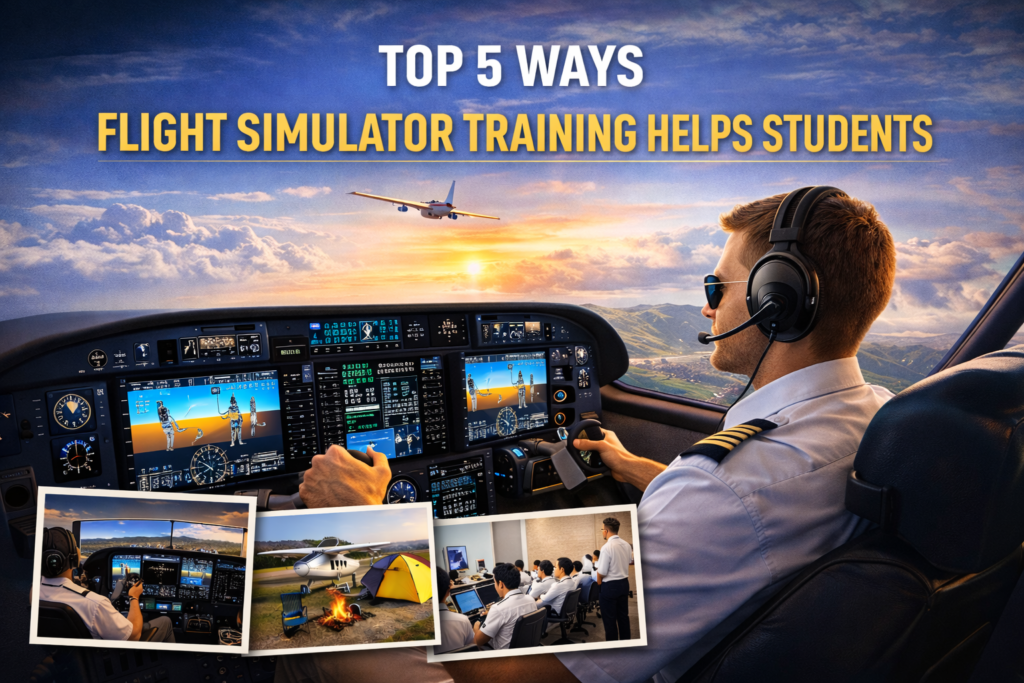
Do you aspire to become a skilled pilot in the future? Then your flying journey will start not with a training aircraft but with a simulator. In this blog, we discuss how flight simulator training helps students become skilled pilots. Read on to learn more.
An aspiring pilot stepping into the cockpit for the first time is quite like a dream coming true. But looking at the complex control systems, with hundreds of switches and complex digital displays, might seem overwhelming for a new pilot.
How can the gap between reading textbooks and flying a multi-million-dollar aircraft be filled?
The answer is through rigorous simulation training. In modern aviation training, it has become the most crucial tool. In India, any flight training academy you enrol in will require you to go through simulation training. It’s not an ‘add-on’; it’s mandatory for trainee pilots.
Let’s explore how simulation training transforms a beginner-level pilot into a skilled one.
What Exactly Is Flight Simulator Training?
A flight simulator looks exactly like a cockpit, replicating all the controls and the environment of a real cockpit. It is a highly advanced technological device that helps trainee pilots learn to fly an aircraft. It features real aircraft controls and even a communication system to communicate with the Air Traffic Control (ATC).
A flight simulator training puts trainee pilots in a highly realistic “dummy atmosphere”, allowing students to practise aircraft handling while on the ground.
You may argue that it does not provide the real feeling of flying an aircraft. Then why use it? Simulation is the ultimate tool for reducing mistakes and eliminating the initial fear of handling an aircraft.
Let’s understand why pilot training and flight simulators are on the same page.
Top 5 Ways Aircraft Simulator Training Helps Student Pilots
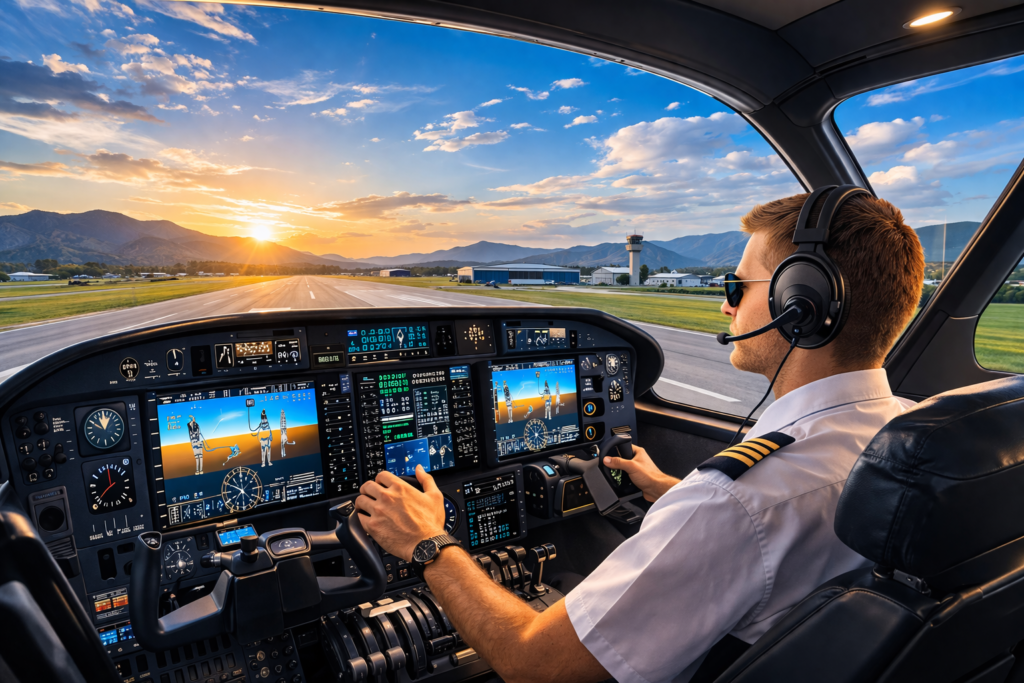
Just as you practise driving on the ground, gradually learning to accelerate and brake when needed, trainee pilots utilise simulation training before taking to the real cockpit. It offers a safe environment, builds muscle memory, and is a cost-effective way to learn flying.
1. A 100% Safe Environment for Mistakes
When you take to the sky as a professional pilot, you have no room for mistakes. But when you make mistakes during an aircraft simulator training, it’s simply a learning opportunity. Simulators provide a controlled environment for trainee pilots to learn complex aircraft manoeuvres.
The simulation training sessions take place under the guidance of instructors, so they can correct students if they make any mistakes. Simulation training offers an opportunity to learn from mistakes.
2. Building Crucial Muscle Memory
A pilot must have intense hand-eye coordination and multitasking ability when flying an aircraft. Flight simulator training helps pilots build muscle memory by familiarising them with the cockpit controls and switches.
Imagine you are flying an aircraft and are about to land on the runway. You must look outside, focused on aligning the aircraft with the runway and crosswinds. At the same time, you will need to control the aircraft using the controls inside.
If you have gone through enough aircraft simulator training, then you can access the exact switches and controls without even looking at them.
3. Mastering Emergency Procedures
Moreover, you can learn the emergency procedures. For example, if there is a sudden engine failure or severe crosswinds, you will know what to do without panicking. When you are under tremendous stress, only rigorous simulation training can save you.
In simulation training, instructors artificially create adverse weather or system failures to train students to handle the situation calmly. Run an emergency checklist and make quick decisions.
4. Highly Cost-Effective Learning
If you are keen to learn how to drive a passenger vehicle, you can simply take a car out on an open road under the instructor’s guidance. But that’s not the case with flying an aircraft. Furthermore, the cost of aviation fuel, maintenance, and rental fees is significantly high for using multiple aircraft for flight training.
Instead, in flight simulator training, you can learn the basics of flight handling, emergency procedures, communication processes with ATCs, etc. Aircraft simulator training ensures that every hour spent in the sky is highly productive for the pilots and the airlines.
5. The Power of the “Pause” Button
Unlike the real flight scenario, the instructors can pause the simulation training midway. If you or any other students are struggling to accomplish a certain manoeuvre, the instructor can pause the session and provide immediate feedback.
This will help you understand your mistakes and practice the manoeuvre until you get it right. No worry about fuel expense or maintenance cost for the aircraft.
One of the greatest advantages of aircraft simulator training is that instructors can literally pause the flight. If a student is struggling with a specific approach or manoeuvre, the instructor can freeze the simulation, provide immediate feedback, and allow the student to redo the exact task until they get it right. This builds immense confidence and drastically reduces the stress associated with actual flying.
For all these reasons, pilot training requires a flight simulator.
Simulator Training vs. Actual Flight Training
Let’s understand the difference between simulator training and actual flight training side by side:
| Feature | Flight Simulator Training | Actual Flight Training |
| Environment | 100% controlled and safe | Subject to real-world variables and air traffic |
| Cost | Highly cost-effective per hour | Expensive (fuel, maintenance, instructor fees) |
| Emergencies | Can safely simulate extreme weather and engine failures | Too dangerous to simulate extreme emergencies |
| Learning Pace | Can be paused, reset, and repeated instantly | Continuous, cannot be paused mid-air |
| Physical Sensation | Visual and procedural realism, but lacks true G-forces | Full sensory experience of flight and gravity |
Table 1: Difference Between Flight Simulator Training and Actual Flight Training
The Crucial First Step: Mastering the Theory
Simulator training is an incredible tool for trainee pilots, but it is useless if you do not clear the basics. Understanding aviation subjects like Air Navigation, Aviation Meteorology, and Air Regulations is crucial to becoming a skilled pilot.
If your theory is weak, you cannot excel in the simulator training season. This is why clearing the ground classes with excellent grades is important.
In a Nutshell
With flight simulator training, aviation students can learn to fly aircraft in a safe environment, having room for correcting their mistakes. Build your confidence, hone your flight skills, and become a successful pilot through simulator training.
Ready to become a skilled pilot? Pass DGCA exams with Cockpit Lessons
Before you take to the sky, build a rock-solid foundation of aviation subjects. Enrol in our ground classes at Cockpit Lessons and learn under expert guidance.
Frequently Asked Questions (FAQs)
Do you provide flight simulator training, and is it included in the course?
Yes, at Cockpit Lessons, we provide flight simulator training. The simulator training is included in the CPL or ATPL course we provide.
Are simulators used for instrument training?
Yes, flight simulators are used extensively to build muscle memory and improve skills in instrument flying and navigation while practicing emergency procedures.
Is flight simulator training alone enough to make me a pilot?
No, simulator training will not be sufficient to make you a skilled pilot. After the simulator training, you will have to meet the required flight training hours.
When does the flight simulator training happen during the CPL journey?
Simulator training is integrated throughout the entire CPL training course. Before the start of CPL, simulators help in understanding how the cockpit works. During ground school, the simulator helps students understand the topics better with real-world scenarios. Even after the CPL, you can hone your skills with flight simulator training.
Can I train solo in a flight simulator?
Yes, you can train solo in a flight simulator. Once you have been trained under an instructor and you know how to use the controls, you can train by yourself in a simulator.
If you are wanting a big win mxbigwin777 is worth a shot. The slots felt generous. Find it here: mxbigwin777
888riovip, eh? Sounds kinda fancy! I’m feeling lucky, so I’m gonna give it a go. Might be my new favorite spot! 888riovip
Winovacasino has some pretty nice options. Gave it a look, might visit it again later sometime. See what they’ve got cooking over at winovacasino.
Spending money on any gaming is always daunting, but kubetkucasino made me feel right at home. Everything felt so accessible to the normal bloke from the UK, like myself, meaning I didn’t end up losing all my money – what a result!
BenVipBet. Not a bad little spot for a flutter. Seen a few good offers knocking about. Give benvipbet a shot, especially if they’ve got a promo on. Good luck!
Downloaded the 89betapp last week. Interface is smooth, and I like the mobile experience. Seems like they have a decent range of games. Definitely worth checking out if you’re looking for a mobile-friendly option. Get it at 89betapp